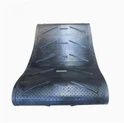
The properties of rubber materials are as follows. The basic characteristics of rubber materials:
1, with high elastic rubber elastic modulus is small, generally in 1-9.8mpa. Large elongation deformation, elongation can be up to 100%, still has the characteristics of recovery, and can maintain elasticity in a wide range of temperatures (-50-+150℃).
2. Viscoelastic rubber is a viscoelastic body. Due to the existence of intermolecular force, rubber is subjected to external force, and deformation is affected by time, temperature and other conditions, showing obvious stress relaxation and creep phenomenon.
3, with the damping effect of rubber on the spread of sound and vibration has a moderating effect, can use this feature to prevent noise and vibration.
4, with electrical insulation rubber and plastic is electrical insulation material. For example, natural rubber and butyl rubber and volume resistance can reach 10
5, temperature dependent polymer materials are generally affected by temperature, rubber at low temperature in the glass state of hard and brittle, at high temperature is softening, melting, thermal oxidation, thermal decomposition and combustion.
6, with aging phenomenon, like metal corrosion, wood decay, rock weathering, rubber will also be aging due to changes in environmental conditions, so that the performance deteriorates and the service life is shortened.
7, must be vulcanized rubber must be added sulfur or other can vulcanize rubber (or crosslinked) substances, so that rubber macromolecules crosslinked into space network structure, in order to have the value of rubber products, but thermoplastic rubber can not be vulcanized.
1, Natural rubber (NR) is mainly rubber hydrocarbon (polyisoprene), containing a small amount of protein, water, resin acid, sugar and inorganic salt, is a non-polar substance, it is dissolved in non-polar solvents and oil. High elasticity, high tensile strength, good tear resistance and electrical insulation, good wear resistance and drought resistance, good workability, easy to bond with other materials, better than most synthetic rubber in comprehensive performance. The disadvantage is that oxygen resistance and ozone resistance is poor, easy to aging metamorphism; Oil resistance and solvent resistance is not good, in cyclohexane, gasoline, thick, before curing dissolved, after curing swelling. Resistance to acid and alkali corrosion ability is low, resistance to 10% hydrofluoric acid, 20% hydrochloric acid, 30% sulfuric acid, 50% sodium hydroxide; The heat resistance is not high. Operating temperature range: about -60℃~+80℃. Production of tires, rubber shoes, rubber hose, tape, wire and cable insulation and sheathing and other general products. Especially suitable for the manufacture of torsional vibration eliminator, engine shock absorber, machine support, rubber - metal suspension components, diaphragm, molded products.
2, styrene butadiene rubber (SBR) and styrene copolymer. The performance is close to natural rubber, is the largest output of general synthetic rubber, its characteristics are more wear resistance, aging resistance and heat resistance than natural rubber, and the texture is more uniform than natural rubber. The disadvantages are: low elasticity, poor resistance to flexure and tear, large heat generation under multiple deformation, poor performance of oil resistance, heat resistance and special kind of medium; The processing property is poor, especially the self-viscosity is poor, the raw rubber strength is low. Operating temperature range: about -50℃~+100℃. It is mainly used to make tires, rubber plates, rubber hose, rubber shoes and other general products instead of natural rubber.
3, butadiene rubber (BR) is made of butadiene polymerization of cis-structure rubber, without plasticizing, belongs to polar substances. The advantages are: excellent elasticity and wear resistance, good aging resistance, excellent low temperature resistance, low heat under dynamic load, easy metal bonding, good chemical stability, can resist the corrosion of most chemicals except strong acid. The disadvantages are low strength, poor tear resistance, poor machining performance and self-viscosity. Operating temperature range: about -60℃~+100℃. Generally more and natural rubber or styrene butadiene rubber and the main production of tire tread, transport belt and special cold products.
4. Isoprene rubber (IR) is a cis-structured rubber synthesized from isoprene monomer. The chemical composition and three-dimensional structure are similar to natural rubber, and the performance is also very close to natural rubber, so it is called synthetic natural rubber. It has most of the advantages of natural rubber, aging resistance because natural rubber, elasticity and strength is slightly lower than natural rubber, poor processing performance, high cost. Use temperature range: about -50℃~+100℃ can replace natural rubber to make tires, rubber shoes, rubber hose, tape and other general products.
5, chloroprene rubber (CR) is made of chloroprene as a monomer emulsion polymerization of polymerization. This rubber molecule contains chlorine atoms, so compared with other universal rubber: it has excellent oxygen resistance, ozone resistance, non-flammable, self-extinguishing after fire, oil resistance, solvent resistance, acid and alkali resistance, aging resistance, good air tightness and other advantages; Its physical and mechanical properties are better than natural rubber, so it can be used as general rubber, also can be used as special rubber. The main disadvantages are poor cold resistance, large proportion, high relative cost, electrical insulation is not good, easy to stick rolling, easy to burn and easy to stick mold processing. In addition, raw rubber stability is poor, not easy to preserve. Operating temperature range: about -45℃~+100℃. It is mainly used for the manufacture of cable sheathing with high ozone resistance and aging resistance and various protective sheaths and protective covers. Oil and chemical resistant hose, tape and chemical lining; Inflammable underground mining rubber products, as well as a variety of molded products, sealing rings, pads, adhesives, such as: building waterproof sheet, building sealing strip, highway caulking materials, bridge support gaskets, wire wrapping, etc.